
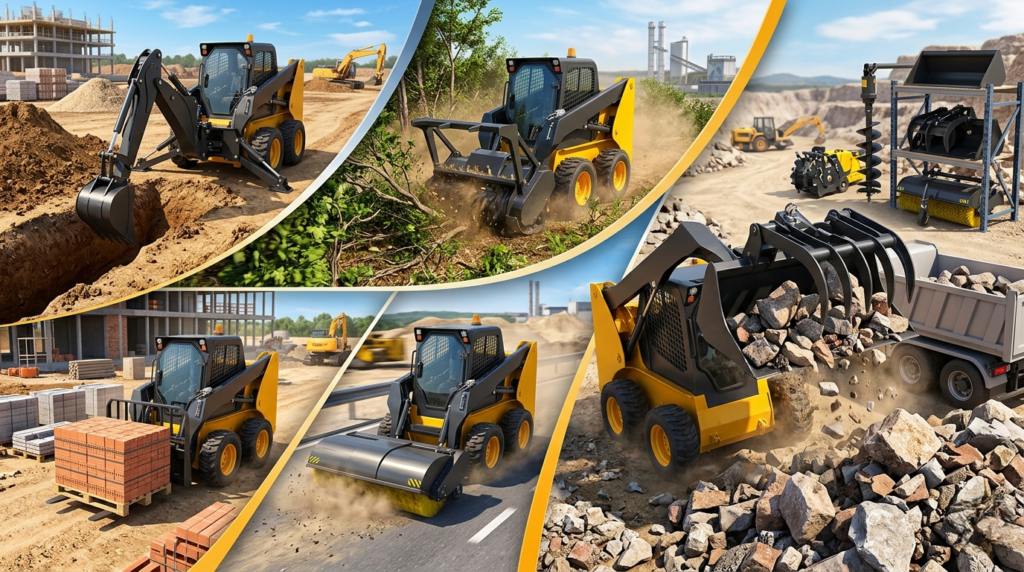
Find out how to choose skid steer attachments to maximize your equipment’s productivity!
Skid steer loaders have been celebrated as the Swiss Army knives of construction, agricultural, and landscaping industries because of their versatile nature. Nevertheless, the real performance and capability of these machines rely very much on the implements attached to their front ends. This is where the real query arises on choosing the best skid steer attachments for maximum efficiency when working on specific task
How to choose skid steer attachments for maximum efficiency
Choosing the right skid steer attachments can mean the difference between finishing a project ahead of time and not having enough capacity or suffering breakdowns. Operators of businesses should not only look at their mechanical characteristics but also work requirements to get the most out of their machines.
Making a strategic decision in choosing the right accessories can turn a single-purpose loader into a multi-functional powerhouse that yields a great return on investment.
Whenever you want to improve your fleet’s operations, first and foremost you must fully grasp the mechanical synergy between the loader and its hydraulic extensions. Purchasing heavy machinery components calls for a breakdown of work site situations, auxiliary hydraulic systems, and load limits.
Investing in quality attachments can lead businesses to eliminate labor expenditures, cut down transport times, and manage multiple kinds of work without purchasing extra large machines. Pairing job requirements with top-quality equipment, operators can get extraordinary speeds and safety levels.
Studying Loader Compatibility and Hydraulics
Choosing skid steer attachments for maximum efficiency starts with a deep examination of your present machine’s physical and performance boundaries. Using a heavy-duty attachment with a light machine that doesn’t meet necessary operating weight or auxillary hydraulic setup is a recipe for component deterioration as well as hazardous situations.
Each skid steer has a specific Rated Operating Capacity (ROC) that should not be exceeded at any time by the total of the weight of the attachment and material being handled.
Also, matching the flow rates, usually measured in gallons per minute (GPM), and system pressure of the loader and the auxiliary attachment is key to avoid failure and sluggishness of the whole system.
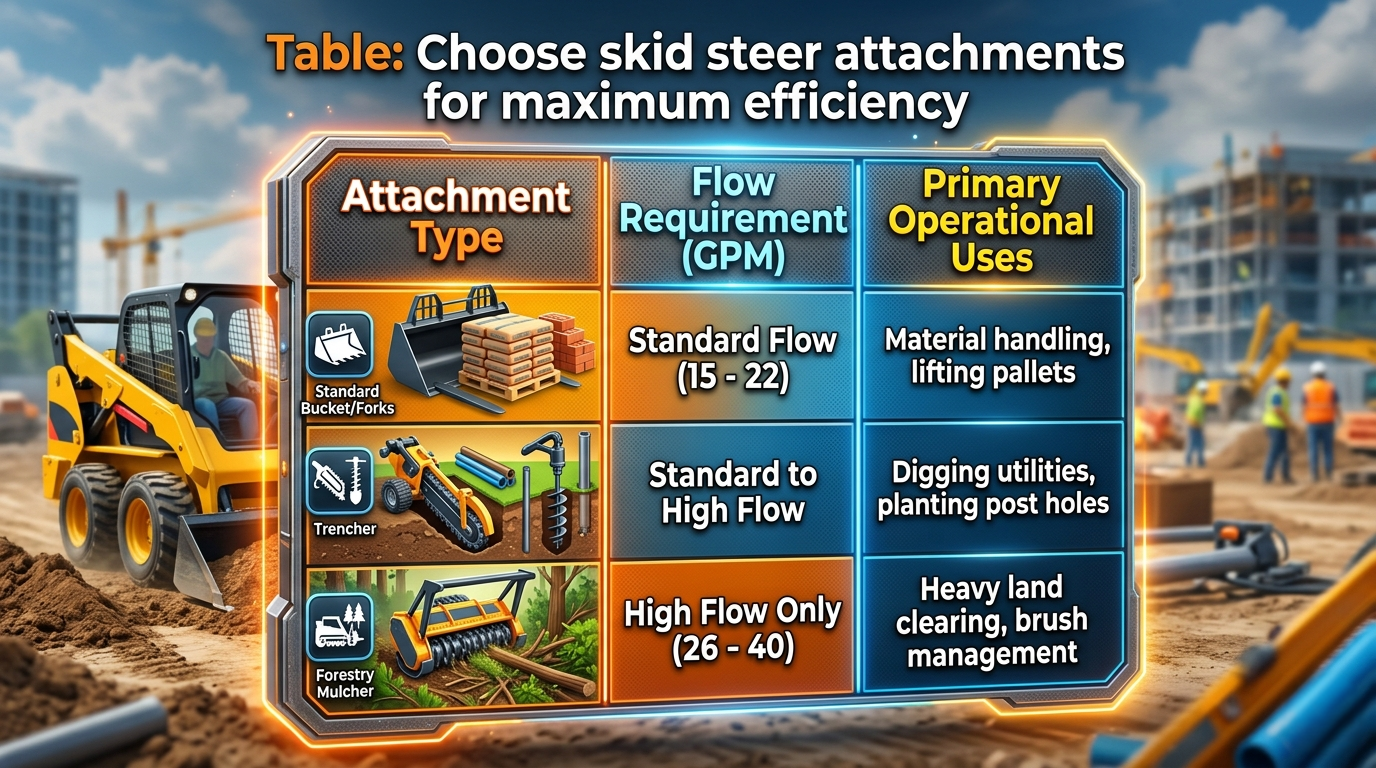
Table: Choose skid steer attachments for maximum efficiency
| Attachment Type | Flow Requirement (GPM) | Primary Operational Uses |
| Standard Buckets/Forks | Standard Flow (15 – 22) | Material handling, lifting pallets |
| Trenchers & Augers | Standard to High Flow | Digging utilities, planting post holes |
| Forestry Mulchers | High Flow Only (26 – 40) | Heavy land clearing, brush management |
- Check the Rated Operating Capacity (ROC): You should always compare the machine’s physical weight limits with the structural weight of the tool and maximum material volume to prevent machine tipping.
- Hydraulic Flow Evaluation: Identify standard-flow and high-flow attachment requirements to determine if your machine’s hydraulic pumps can provide the necessary delivery rate.
- Quick-Attach Coupler Check: Your loader should have a universal quick-attach system allowing good mechanical coupling with no hydraulic fluid leakage even in heavy use.
Material Handling Equipment – Warehouse and Logistics Applications
Successful materials management constitutes the main pillar for warehouse, industrial, and major supply yard logistics. Employing standard skid steer buckets or heavy-duty pallet forks converts your compact loader into a nimble, high-capacity material handler capable of navigating tight aisles.
- Use Pallet Forks for Orderly Loads: Heavy-duty forged steel forks with adjustable widths can handle different pallet structures safely and reliably in a variety of rough terrains.
- Install Heavy-Duty Grapple Buckets: Select solid-bottom or rock grapple buckets to clamp down tightly on log removal, debris collection, and scrap metal.
- Go for Multi-Purpose 4-in-1 Buckets: Operating such a bucket is like doing the work of a dozer, scraper, grabber, and standard material loader at the same time.
Landscaping and Civil Works Using Earth-Moving Tools
Landscapers and civil engineering contractors constantly change geological conditions, and therefore, precision grading, soil preparation, and deep excavation will be required at some point.
Selecting tools such as rotary tillers, land levelers, and special lawn scarifiers can help the crew quickly convert hard, compacted soil into loose seedbeds. For paving roads or setting foundations, heavy-duty bull dozer blades and lawn mowers give you control over surface shapes with great precision.
Operators who choose the right terrain management attachments can forget about secondary manual labor and obtain uniform professional-grade results over large project sites.
- Use Rotary Plow Tillers: Softening seedbed soil profiles is quite possible as rotary tillers will help break up even the hardest clays and compacted soils.
- Adopt High-Performance Sweepers: Active site cleaning keeps sites clean, safe, and professional with sweepers collecting mud, dust, and gravel.
- Utilize Heavy-Duty Dozer Blades: To rough grade stone, cut land contours, and level topsoil, a compact loader with a bull dozer blade is very effective.
Optimizing Excavation and Utility Operations with Augers and Trenchers
Digging accurate trenches for things like utility lines, irrigation, or footings requires a particular type of equipment that is not only fast but also very precise. With high-torque planetary augers, contractors can drill deep post holes even in rocky soils, icy ground, and thick roots.
Also, the use of high-durability continuous trenchers allows cutting of clean vertical trenches, thus greatly enhancing the speed compared to manual digging or regular mini excavator buckets. A trench filler trailing the crew can be used for rapid, automated backfilling, which essentially completes the job in half the time.
| Excavation Tool | Max Operating Depth | Best Geological Terrains |
| Hydraulic Earth Auger | Up to 1.5 – 2.5 Meters | Clay, rocky earth, compacted soil |
| Continuous Trencher | Up to 800 mm (Single Pass) | Landscaping patches, irrigation corridors |
| 3-Tooth Ripper | Sub-surface penetration | Fracturing asphalt, ice, hard pan earth |
- Use Hydraulic Earth Augers: Combine powerful auger drives with variable bit sizes to drill identical holes for fences, trees, and foundations.
- Operate Continuous Heavy-Duty Trenchers: Use strong chain systems to maintain consistent depths for electrical and water utility corridors without disrupting the surrounding sodded areas.
- Sub-surface Rippers: Separate compacted soils, asphalt, or thick ice using multi-tooth rippers prior to the main excavation operation.
Demolition and Forestry Work with Extreme-Duty Attachments
Demolition and heavy forestry work significantly stress skid steer components, making it indispensable to use attachments made of top-quality materials. If you want to clear dense woods, a forestry mulcher or brush cutter will turn thick brush and small trees almost immediately into mulch.
- Attach Hydraulic Concrete Breakers: They are ideal for delivering a huge amount of impact energy for breaking up pads, foundations, roads, rocky surfaces, and the like.
- Fix High-Speed Flail Mowers: They mow dense overgrown vegetation, bushes as well as saplings at a high speed even when operating on uneven terrain.
- Make Use of Stump Grinders and Log Grabs: Both tools come with a hydraulic mechanism for a safe level of operation, whereby stump grinders put the stumps below ground level, and with log grabbers, you are able to lift heavy logs.
Consider Purchase vs. Rent for Cost-Effective Attachment Spending
Efficiency of operations is maximized when fleet managers perform detailed financial analysis that compares buying attachments upfront to renting them only when needed.
Purchasing heavy equipment components is a wise long-term investment for things that are core to everyday operations such as material loading and lifting, besides providing instant availability of assets.
However, special and specialized attachments like snow blowers or asphalt planers are perfect candidates for rental programs that can save overhead costs during the off-season.
- Think over Core Attachment Utilization: You must use your capital to invest in high-use buckets, forks, and grapples because these are in operation for more than 75% of the time.
- Rent Seasonal Items: Snow blowers, heavy rock breakers, etc. are examples of specialized gear only suitable for temporary contracts and can be rented.
- Account for Maintenance and Storage: Don’t forget to consider the costs of structural storage and technical upkeep when buying specialized hydraulic attachments.
FAQs – Choose skid steer attachments for maximum efficiency
How do I know if my skid steer is standard flow or high flow?
Locate the technical specification guide from the manufacturer’s website or review the dashboard info panel inside your loader to confirm the hydraulic capacity of your machine. Standard-flow systems usually provide operators with 15 to 22 GPM of water, and high-flow ones are 26 to 40 GPM or more. Being in-sync with such output not only keeps components from getting too hot but also ensures max efficiency of the attachment.
Is it possible to attach any brand equipment to my skid steer?
Most compact machinery manufacturers nowadays use a universal quick-attach system, which means frames made by different brands can be fitted on a platform quite well. In any case, one should always verify hydraulic coupler compatibility, pins for electronics connection, and flow requirements. Usually, a different brand attachment calls for a thorough check not only of physical dimensions but also of hydraulic system alignment.
What is the impact of using a high-flow attachment on a standard-flow skid steer?
A high-flow attachment brought to work with a standard flow loader will be very slow, inefficient, and low in production. As the motor does not get enough fluid volume, it cannot reach its speed and throughput targets. In addition to that, this incompatibility may increase backpressure, cause stalling, and eventually wear down the pump.
What is the load a mini skid steer can safely lift?
The capability of a mini skid steer to lift safely depends primarily on its Rated Operating Capacity (ROC), and for heavy-duty commercial units such as the TYPHON STOMP range, the ROC can reach up to 2,000 lbs. Operators should adhere to this limit strictly, as going beyond it could result in the rear wheels being lifted off the ground, thus leading to tipping and mechanical failures.
Which skid steer attachment can do the job of getting rid of thick brush and small trees?
A review of land clearing operations will suggest that a heavy-duty forestry mulcher or a brush cutter attachment is the most appropriate equipment for resourceful working on dense woods and thick brush, even up to the point of small trees. These machines are fitted with high-speed drums which are equipped with carbide teeth or durable flail blades, designed to grind overgrowth, saplings, and stumps into mulch rapidly.
How frequent is the greasing and maintenance schedule for my skid steer attachments?
The high-impact or rotating hydraulic attachments such as rock breakers, augers, and tillers will necessitate greasing every 4-8 hours of their active use. Meanwhile, simple non-hydraulic attachments like pallet forks and general-purpose buckets require grease and a structural inspection on a weekly basis. Regular maintenance checks help avoid early pin wear and costly job site downtime.
What makes a 4-in-1 bucket an excellent investment for efficiency?
First of all, a 4-in-1 bucket allows the operator to do four different work types with a single tool. You can use it as a regular dirt bucket, a bulldozer for pushing material, a clam grabber for handling wood or pipe, and a bottom-dump scraper. This variety means that the operator can instantly switch from one to another without even leaving the cab for the tool change.