
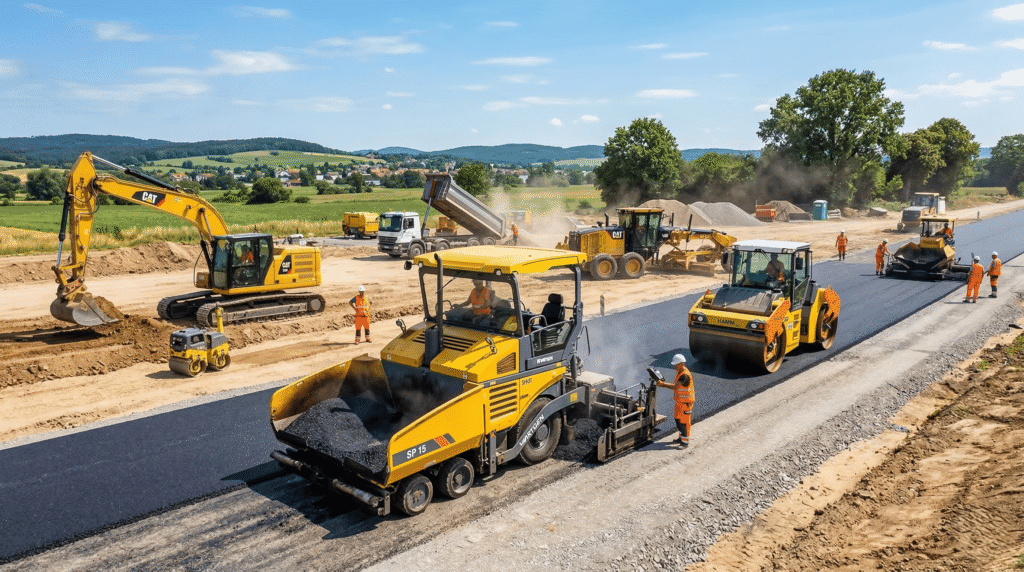
Maximizing Efficiency with Compact Road Construction Equipment for Small-to-Medium Projects
One of the main concerns when handling small-to-medium infrastructure projects is often the limitation of the physical space at the worksite. Heavy traditional machinery often turns out to be too big to function even in residential cul-de-sacs, narrow city alleys, or private estates. Compact road construction equipment is a “saving” factor here, as it offers the optimal mix of raw hydraulic power and a small footprint.
Besides this, using these equipment also gives contractors an opportunity to keep operating production cycles at a high pace without dealing with the further complications of transporting oversized units. By concentrating on agility, these tools make sure that every small area within the project site is accessible and properly treated.
Compact Road Construction Equipment Importance
The trend towards smaller, more efficient machine is not only about getting rid of trouble, it’s a smart strategy to lower overhead costs and reduce the environmental footprint. Compact road construction equipment uses generally less fuel and needs fewer operators, which makes it a better economic option for local government entities and private sector developers.
New driveway or patching up a secondary road — the right choice of equipment has a big say in the final pavement durability. Leading the pack in the compact heavy equipment industry, TYPHON Machinery holds the record for the industrial grade durability of its products that is not compromised by their comparatively smaller size. Hence, meeting highway standards at a small scale is no longer a problem for their customers.
Step-Wise Preparation – Compact Road Construction Equipment
1. Site Preparation: The Role of Precision Grading
Underneath a road, the real secret to its success involves the preparation and leveling of the subgrade. At smaller scale, you’ll want equipment that can keep on point grading without disturbing the surrounding landscape or existing utilities.
Compact site-preparing road construction equipment makes it possible for the excavation to be so precise that only desired portions of the terrain are removed/fixed because each scoop is accurately measured.
- Mini Excavator: If digging drain trenches and removing old footings are on the agenda and the place is too small for a full-sized digger, then mini excavators are definitely the best choice.
- Skid Steer Loaders: Instantly compatible for zero-turn radius actions, graders or blades turned for skids can be attached so the operator can clear debris and level soil at great speed.
- Compact Track Loaders: These are the skid steer tracked version allowing great flotation, which is necessary when working on soft or sandy ground, and which also combines very high pushing power.
2. Streamlined Material Handling and Transportation
For aggregate, sand, and hot-mix asphalt transport within a medium-sized site, a continuous and rhythmic flow is the key in order not to cool off the material and not to keep the team wait.
Loader type compact road construction equipment is engineered in such a way so that, even in cramped places, they can be brought around and used to transferring between stockpiles and the paving zone. Speed of a loader in making a truck full or another one with asphalt is dumped into the paver – that is what determines that efficiency in here.
Small loaders allow for better site accident safety measures since the better visibility that they give an operator allows for making safer decisions in the overcrowded environment.
- Compact Wheel Loaders: Due to their high travel speeds and excellent lifting capacities, these units are perfect for loading small dump trucks as well as moving pallets of firewood or paving stones.
- Mini Dumpers: No larger than a small car, these little workhorses get into areas where trucks can’t go, and their 1-ton capacity makes them perfect for dumping material.
- Backhoe Loaders: In small/medium construction works, backhoe loaders find themselves in the center of tasks, often utilized for excavating, trenching, and with quite a bit of labor-saving ability, such as their quick change, two-function dual purpose capabilities.
Table: Benefits of Different Machine Types
| Machine Type | Key Benefit | Typical Application |
| Compact Wheel Loader | High Mobility | Loading & Material Transport |
| Mini Digger | Versatility | Trenching & Utility Work |
| Skid Steer | Maneuverability | Site Clearing & Grading |
3. Paving and Surfacing for Smaller Footprints
Applying the final top wear course is the most visible part of the operation, and it requires specialized compact road construction equipment that can deliver a flawless finish. Small sized pavers have a smaller width capacity which is usually the width of a standard driveway or a bike path.
This helps to reduce the manual raking and hand finishing. These are fitted with heated screeds that keep the asphalt at the right temperature for a good bond. Paving with the right size equipment basically means that the whole process will lead to a neat, lasting surface appearance that can withstand the climate conditions for a very long time.
- Mini Asphalt Pavers: Ideal for sidewalks, narrow residential roads, patching jobs – in fact, the perfect choice for almost any kind of small-scale asphalt paving — are laid in widths as narrow as 1.5 meters by these>
- Bitumen Sprayers: Compact towed or skid-mounted sprayers are used to apply a “tack coat” which is the glue between the layers of asphalt, and the ensuring uniform is the main function
- Cold Planers (Milling Attachments): Using a cold planer attached to a skid-steer vehicle can help to precisely mill away excessively raised spots or damaged portions of an old road.
3. Final Compaction and Surface Sealing
Compaction at the required density is an essential step in any road construction project. Roads will inevitably fail if there is air trapped in asphalt or soil. Compact road construction equipment such as tandem rollers and vibratory plates are good for this since they provide the “kneading” type of action necessary for the layers to solidify.
To maximize the compaction level, which is a pretty high 95% or more, a smaller roller in medium projects is usually a good choice because the operator will be able to get within closer proximity of curbs, walls, and manholes. This will allow the assurance that there is not a weak spot in pavement edges.
- Tandem Vibratory rollers: The majority of asphalt finishing work is done with these. They have two smooth drums that flatten and consolidate the material as vibratory forces help the aggregate to settle.
- Trench Rollers: Remote control for safety in use is a feature of these very narrow excavations specific units. They compact the soil in trenches so as to prevent future sinking of a road over utility lines.
- Reversable Plate Compactors: Very useful for “spot compaction” jobs in corners or around drainage grates, where rollers are not only too large but physically can not get to the spot.
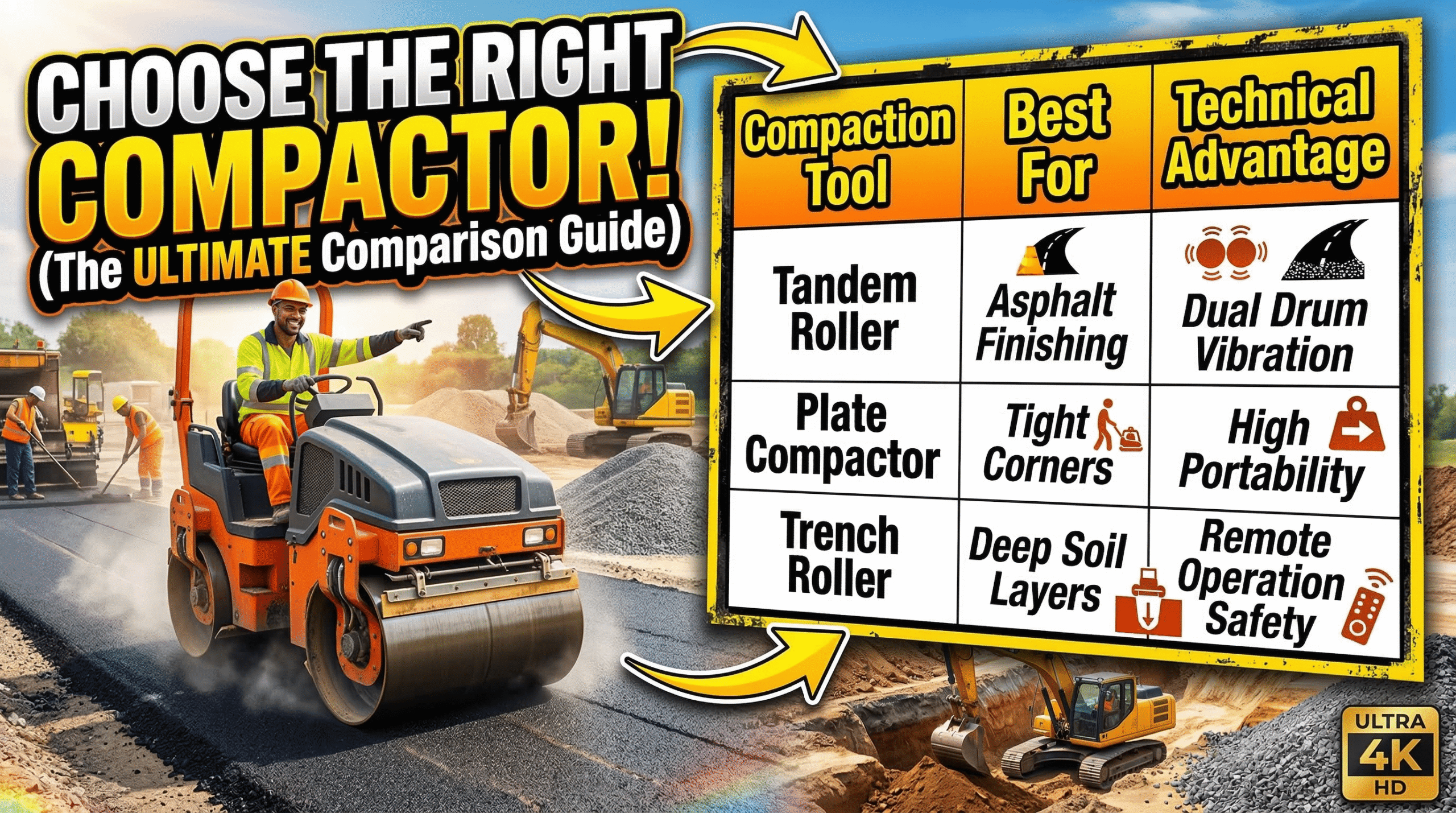
Table: Compaction Tool Advantages
| Compaction Tool | Best For | Technical Advantage |
| Tandem Roller | Asphalt Finishing | Dual Drum Vibration |
| Plate Compactor | Tight Corners | High Portability |
| Trench Roller | Deep Soil Layers | Remote Operation Safety |
4. Maintenance and Operator Excellence
As with any good quality compact road construction equipment, the investment has to be viewed as the long run and therefore adherence to a regularly scheduled routine maintenance is essential if one is to guarantee the reliability of the equipment.
Due to the fact that these machines are sometimes used in residential or heavy traffic areas to perform their work, operator training needs to be focused on both safety and accuracy. Operating a well-maintained machine by skilled hands remains the best way to produce high ROI and a large base of satisfied clients.
- Hydraulic System Health: Spare a few moments to look over all hoses for signs of leaks or abrasions. These high-pressure systems found on compact units are under constant stress.
- Attachment Care: Make it a point that attachments are watered with grease daily and the locking mechanisms are secure so that during operation, there won’t be an accidental detachment.
- Operator Safety: Speaking of Rollover Protective Structures (ROPS), always wear your seat belt and make sure that all backup alarms, as well as lighting systems, are working properly for night-time or low visibility operations.
FAQs – Compact Road Construction Equipment
What is the best compact road construction equipment for residential driveways?
Running a Skid Steer will be the best double act for tailoring a driveway and getting a uniform finished surface using Mini Asphalt Paver.
How does compact road construction equipment improve project ROI?
Not only do compact machines offer less power consumption, but they can also be towed using significantly smaller trailers, and in addition, they need fewer crew members to run them. This results in hefty savings in the overall project cost per square foot.
Can I use a mini excavator for road compaction?
A mini excavator is capable of being fitted with a “compaction wheel” attachment for trenches but for the final asphalt surface it is essential to use a dedicated vibratory roller in order to obtain a smooth, driveable finish that is flat.
What are the benefits of using TYPHON Machinery for small projects?
With their compact design combined with superior quality manufacturing, TYPHON machines are the answer for tight urban locations. Their durability is that of industrial-grade heavy machines.
How often should compact paving equipment be serviced?
Start each day with a pre-operational inspection. Regular service intervals are usually scheduled every 250 to 500 hours of operation, which include the changing of oil, filters and the checking of hydraulic systems.
Is GPS technology available for compact road construction equipment?
It is possible to fit a GPS-guided grade control system onto many compact graders and excavators, which would provide them with millimeter-precision leveling and drainage abilities.
What is the difference between a smooth drum and a padfoot roller in road work?
Road work rollers with smooth drums are mainly utilized when it comes to finishing layers of asphalt and gravel. On the other hand, padfoot rollers, also called sheep’s foot rollers, are normally used for subgrade phases that involve clay or other types of cohesive soils.