
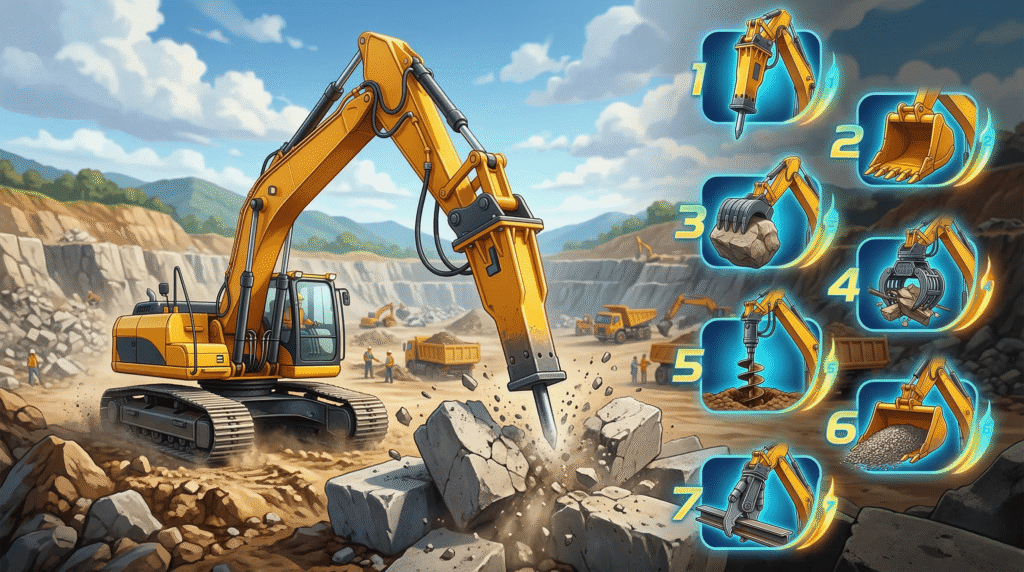
7 Excavator Attachments to Turn Your Excavator into a Multi-Tool Powerhouse
Maximizing the efficiency of your fleet begins with the realization that your machine’s capability depends largely on the tools it carries. Contractors and business owners who are looking for ways to improve their return on investment will find the feature of transforming a simple digging machine into a versatile utility powerhouse extremely appealing with multitudinous powerful excavator attachments.
Adding certain excavator attachments to your excavator enables you to replace several pieces of dedicated machinery with one highly capable machine that has very few limitations.
The benefits of such a transformation go much beyond mere convenience; they encompass enhanced operational efficiency and lower costs as well. An operator will significantly spend less time manually digging when a machine is equipped with the proper tools.
At the same time, having an equipment set that can be used for different purposes helps to eliminate downtime caused by waiting for specialized machines and tools to be delivered to the job site. Let’s walk through some of those essential components you will need in order to start working your machine as a multi-tool one:
Top 7 Excavator Attachments to Turn into a Multi-Tool Powerhouse:
1. Quick Hitch Couplers Enable You To Switch Attachments At Lightning Speed
The quickest way to dramatically improve the efficiency of your multi-tool system is by getting the highest quality quick hitch coupler. This piece of equipment not only allows seamless and fast transition between different attachments but also doesn’t require the operator to leave the cab during the process. One single upgrade like that can literally double your daily productivity.
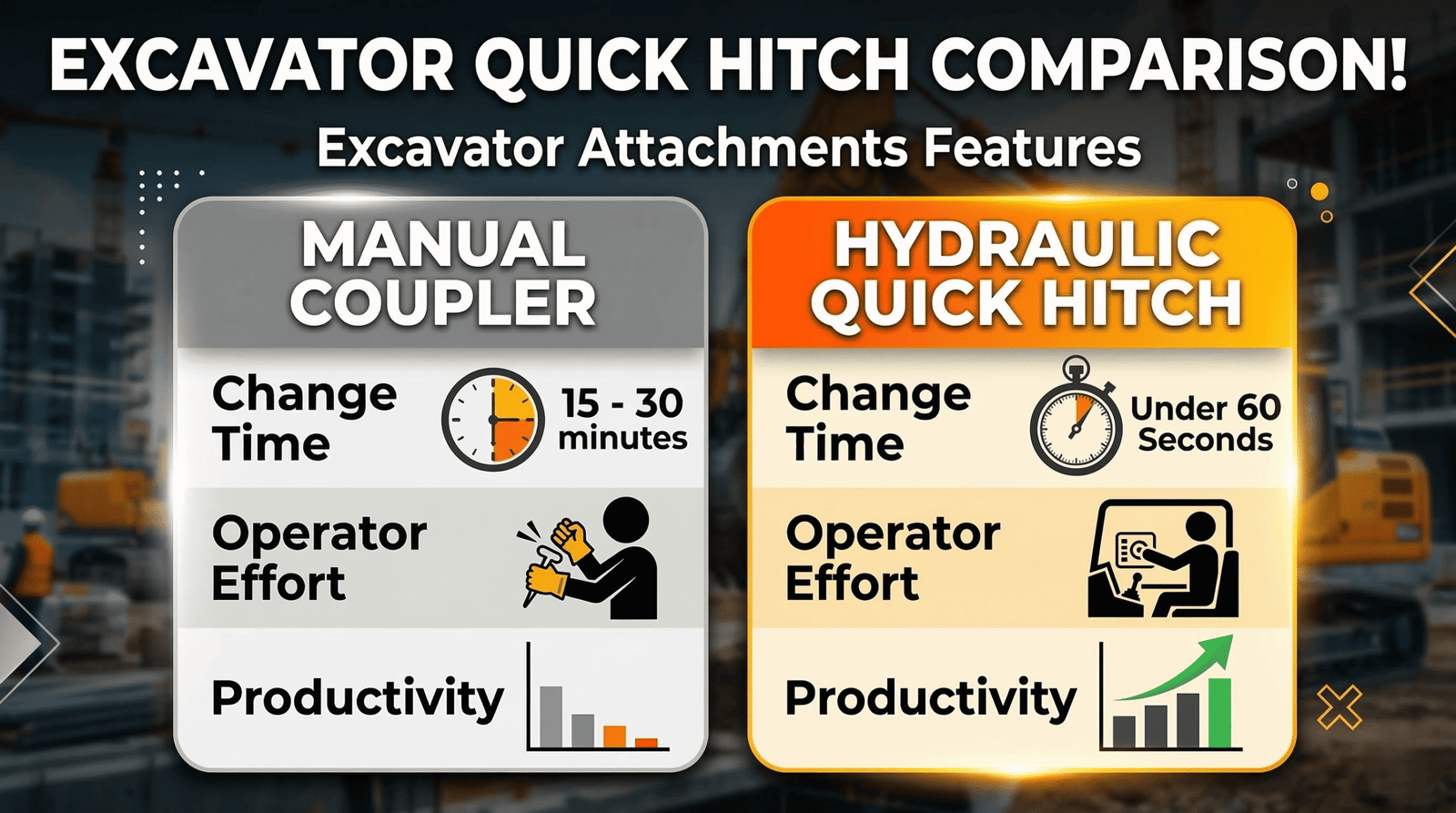
- Lock and Load Your Tools in No Time: While a manual changeover might take as much as 20-30 minutes, a quick hitch can perform the same work in a matter of seconds.
- Enhanced Safety: Double your Safety with Device that Get Locked In Place Before You even Start Working: Most modern types come with a locking mechanism which makes sure the attachment is firmly held in place at all times.
- Universal Compatibility: TYPHON quick hitch is the one you should go for if you want to have a quick hitch that is compatible with the widest range of different tools.
Table: Excavator Attachments Features
| Feature | Manual Coupler | Hydraulic Quick Hitch |
| Change Time | 15 – 30 Minutes | Under 60 Seconds |
| Operator Effort | High (Manual Labor) | Low (In-cab control) |
| Productivity | Low (High downtime) | High (Continuous work) |
2. Sturdy Trenching and Digging Buckets
It is a fact that the standard bucket is not specially designed for a particular digging task. But with trenching buckets, you can perform almost all types of digging works without the need for changing the bucket.
By definition, trenching buckets are narrow and have side cutters which are specially meant for making excavations of utility lines, cables, and drainage systems. Besides, using a properly sized bucket helps eliminate over-digging, which indirectly leads to savings on backfilling time and material cost.
- First Class Cutting: Widths as narrow as 200mm up to 550mm give the possibility of ditching in very good condition.
- Material of Highest Quality: Through the application of heavy gauge alloy steel, these units are capable of resisting various types of abrasive materials without suffering wear.
- Perfect Shaping: The radius of the bucket is designed to generate the greatest breakout force which enables even very small excavators to do the work of larger ones when it comes to hard ground.
3. Hydraulic Earth Augers
For landscaping, fencing, and foundation work, the hydraulic earth auger is an indispensable tool. It replaces the back-breaking labor of manual post-hole digging with a high-torque, planetary-drive system that can penetrate even compacted or rocky soil.
By mounting an auger on your excavator, you gain the benefit of the machine’s reach and down-pressure, which a hand-held unit simply cannot match.
- Versatility at the Bit End: Normally you will have standard bits for soil, but only a few bits are designed for tough rock conditions.
- Millions of Feet Below: Like most other fixing tools, you can extend the length of drilling ends so that it penetrates deeper than ordinary earth augers did.
- Stable: Because of the support hydraulic system where excavator receives torque continuously, this feature mitigates power losses produced in small power heads that have “stalling” problems.
4. Hydraulic Hammers
Your need to make breakages on concrete slabs, rocks, etc., then a bucket won’t do the job adequately. A hydraulic hammer or rock breaker that uses the extra hydraulic supply of the excavator to accomplish certain movements can help, in this case, to some extent, replace the bucket. If you are going to demolish a slab or foundations, then go for it.
- Power At Impact with Safety Parameters in Mind: The machine’s framework and structure are hardly vibrated while the energy to make fractures is at peak.
- Well Going Where the Large Ones Cannot Even Reach: Its slenderness and length are the advantages of the breaker’s profile allowing for crushing work even in very tight spaces.
- Reduce Cost by Minimizing Downtime: Hammer that operate with modern technology like “top types” do not have as many moving components as the older ones which simply means fewer breakdown and time for repairing.
5. Grapples and Thumb Attachments
Dealing with bulky, irregularly shaped materials like tree trunks, scrap metals or demolition waste is a serious challenge if you rely on a bucket only.
A grapple or a hydraulic thumb is like an “opposable thumb” to your excavator, allowing you to grip, lift, and accurately place the objects which is quite impossible with a bucket. Besides, in operations involving land clearing and recycling, the material sorting is the major activity; hence grapples are very useful.
- Superior Grip: Extreme Clamping Finger tines wrap around the full 360 degrees so that load does not slip away easily.
- Working Safety that is Enhanced: When material is clamped tightly, we have taken a step toward the elimination of dropout of debris during transportation across the work site.
- Accuracy Through Hydraulic Power: It allows the operator to adjust the clamping force; hence, the management of the handling of smooth pipes or the aggressive crushing of metal scrap is achieved easily.
| Task | Bucket Only | With Grapple/Thumb |
| Moving Logs | Very Difficult | Efficient & Secure |
| Scrap Sorting | Inefficient | Highly Productive |
| Rock Placement | Unstable | Precise & Safe |
6. Ripper Hooks
Frozen earth can be the big problem sometimes, or when it is heavy clay, then it is the ripper hook which is ready to be sent to the ground. Concentrated exertion of the excavator’s breakout force is what the single tooth, shark fin design of the tool does, tearing and breaking up the hard ground so that after this job, a bucket can do its job more easily.
Besides it, the time taken for the digging operation and also the wear and tear of the arm and pins of the machine is lessened.
- Strength: Also, the ripper can help you in clearing up tree roots and snags on the site, shale rock, and compacted gravel.
- Fuel Saving: When the ground has been broken beforehand, the machine encounters much less resistance and therefore consumes less fuel during the actual excavation process.
- Shank at Its Best: Made from high-grade steel, full forging for the extreme prying force requirements in heavy site preparations.
7. Leveling and Grading Buckets
The standard digging bucket can hardly be compared to these specialized buckets when it comes to providing the final site with a smooth and level finish. Leveling or ditching buckets feature a relatively wide and flat edge without teeth which enable the operator to “skim” the surface of the soil giving a perfect grade for lawns, driveways, or slab foundations.
These closed ends buckets also have the capability to tilt providing greater dexterity on complex slopes and drainage angles.
- Instrumental in Raising Profit Margins: Being available in widths of up to 1000mm, these buckets are able to cover more ground per pass, thereby speeding up finishing.
- Provide a Finishing Amongst the Best: With its tooth-less design, the bucket ensures a clean surface which will result in minimum of manual raking or secondary grading equipment after.
- Used a Lot for Moving Materials: Besides being very efficient in moving huge amounts of loose materials such as gravel, sand, and topsoil quickly.
FAQs – Top 7 Excavator Attachments
What is the most versatile excavator attachments?
A quick hitch coupler keeps topping the list as the “most versatile excavator attachments” by being capable of using almost all other tools. As for the performance of a specific task, a hydraulic thumb holds the number one spot by giving the machine the ability to function not only as a digger but also as a material handler.
Can I use different brands of attachments on my excavator?
Yes, most mini-excavators use a standard pin-on system. By using a universal quick hitch, you can often adapt attachments from various manufacturers, provided the pin diameter and ear width are compatible with your machine’s weight class.
Do mini-excavator attachments require extra hydraulic lines?
Powered attachments like augers, hammers, and grapples require an auxiliary hydraulic circuit (the “third line”). Most modern mini-excavators come with these factory-installed, but you should verify your machine’s flow rate (GPM) before purchasing.
How do I choose the right size bucket for my excavator?
Bucket size should be matched to the machine’s operating weight and the density of the material. A bucket that is too large can tip the machine or cause excessive wear, while one that is too small reduces efficiency. Always refer to your machine’s lift capacity chart.
Is a hydraulic thumb better than a mechanical thumb?
A hydraulic thumb offers significantly more control and can be retracted when not in use. A mechanical thumb is fixed in position and requires the operator to move the bucket toward it, making it less efficient for complex sorting tasks.
What maintenance do hydraulic attachments need?
Hydraulic attachments require regular greasing of all pivot points and inspection of hydraulic hoses for leaks. Hammers, in particular, require frequent greasing (every 2 hours of use) to prevent damage to the tool steel and bushing.
Can a mini-excavator handle a forestry mulcher?
Yes, but it depends on the hydraulic flow. Some mini-excavators have a “high-flow” option specifically designed to run demanding attachments like mulchers or flail mowers. Ensure your machine’s cooling system is rated for the continuous duty these tools require.