
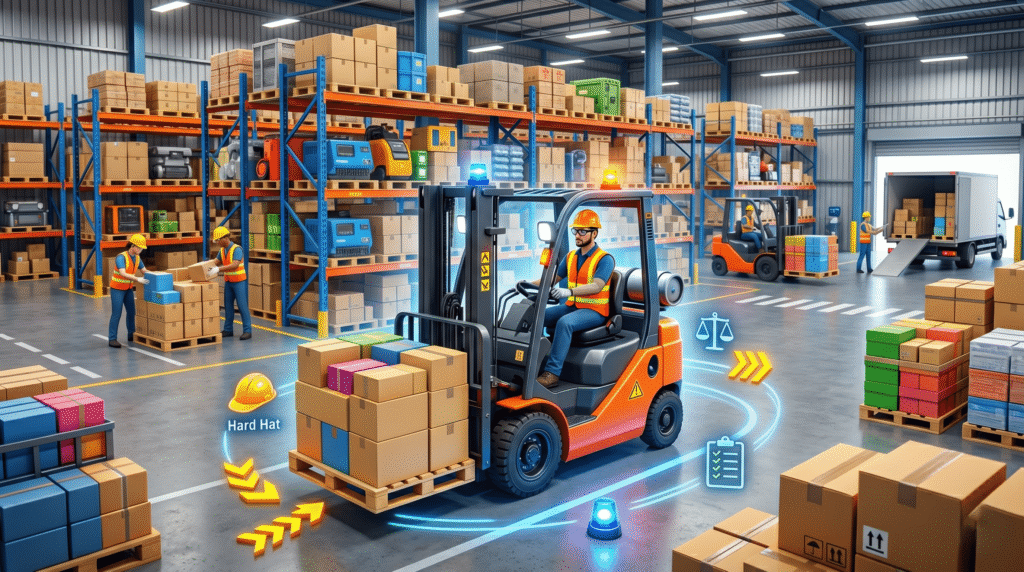
Top 10 Forklift Safety Tips: Don’t Let Forklift Safety Improvements Deter Your Sales Potential
Forklift operations are the core of warehousing and construction logistics, combining seamless inventory and client delivery. However, the potential of these machines is stunted by operational accidents and mechanical mishaps. Forklifts are heavy machines, and when sidelined due to forklift safety violations or mechanical issues, the entire supply chain is negatively impacted.
Avoiding operational forklift safety issues preserves the reputation of your company by limiting missed deadlines and preventing extended downtime overall. The reputation of your company is the reliability of your operations and the goodwill will translate into the operational safety of your company, leading to commercial and professional quality business leads.
Top 10 Forklift Safety Tips:
1. Prior to Operational Inspections, Be Thorough
To maintain a competitive advantage, your first focus should be operational safety. The first step to operational forklift safety is a detailed inspection before operational shift. Inspections should be done on every single shift to mitigate operational accidents.
Inspections should uncover minor issues to minor leaks and tire issues that are easily repairable to more major issues that are not easily repairable. Inspections should be done to keep the machines operational and to keep the flow of productivity steady.
Inspections done to document the machines and keep logs can be done to show the stakeholders. Inspections should be done to show operational excellence.
- Carefully Inspect hydraulic oil, Engine oil, and coolant levels to avoid overheating and systems failing.
- Look at the mast and see if there are any structural cracks, and see if there are bent forks which may affect the stability of the load.
- Ensure that there are no collisions by checking that the device’s horn, backward alarm, and blinking lights are working.
2. Practice Precision Load Control
Rated capacity of a forklift being exceeded is one of the primary factors contributing to accidents and structural damage to equipment in the workplace. To manage load with precision is to be clear about the load with its weight and center limits.
This is to ensure that every suspension and hydraulic system is served within specified limits. Each time a load is managed within stated limits, the life of the equipment is significantly prolonged. Maintenance is also reduced. This discipline of work attracts reputable clients. Such clients are in search of partners with logistics that are reliable.
- Confirm the maximum weight capacity before making any lifts to the load by checking the data plate.
- When positioning the load, be sure it is well centered and evenly spread to the forks.
- For irregular loads, use the correct attachments to control the load and ensure the center of gravity falls within the machine operational.
3. Keeping Floors Safe and Clear
It is important to have a safe and clean workplace when operating a forklift. Keeping the floors clean and free from obstructions will save the tires from wear and prevent the forklifts from skidding and tipping.
Being considerate of the floors reduces downtime due to tipping and skidding. Warehouse obstructions can delay work and increase the chance of an accident. By organizing the floors, you create an environment where forklifts can move without hazard and increase daily work output.
- Aisles and paths for forklifts should be free of obstructions.
- Use visible markings and signs to distinguish between pedestrian and operational areas.
- Inspect the floors of the warehouse for damage to ensure the forklift components remain intact.
4. Consider Making the Additional Investment for Operator Training
Forklift operator training isn’t just about the safety of the employee. Training reduces all types of forklift safety incidents. Training has shown to reduce impacts from the forklift to the racking systems (called “fender benders”).
Training in emergency response and basic troubleshooting of the forklift allows the employee to contain minor incidents. Incidents that may keep the forklift in the shop for extended repairs. Training improves the reputation of your company in the area of safety and efficiency.
- Operators should attend annual training to review the most updated OSHA safety laws and new forklift models or machinery being used.
- Training should have components that teach and allow practice for the operator to gain experience in maneuvering tight and congested areas.
- Operators should come from the training program with a mindset that encourages them to bring potential forklift safety hazards to the attention of the management without concern for discipline.
5. Make a Proactive Maintenance Schedule
A “run to failure” approach to maintenance will cost us more in downtime and even more in lost profits of our fleet. A proactive maintenance schedule will service the forklift based on the clock or the hours of usage.
A proactive maintenance schedule anticipates the issues that will occur from the normal operation of the forklift. A proactive maintenance schedule allows for the loss of parts replacement to occur during an off-peak time rather than during the middle of a big contract.
Without a proactive maintenance schedule your company may experience loss of contracts because of the inability to meet the efficiency requirement.
- Consider scheduling operational hours deep system diagnostics to uncover electrical or hydraulic problems.
- Have sufficient inventory of commonly used spare parts to minimize downtime over routine replacements.
- Ensure machine integrity by teaming up with a trusted equipment supplier for quality OEM parts and professional maintenance.
6. Improving Speed and Braking Systems
Speed is a key cause of warehouse accidents endangering pedestrians and causing inventory damage. Speed limits and braking systems give operators the time to respond to unexpected hazards.
Operating at a slower speed also limits the number of delays caused by minor collisions. A safe environment will help win over customers and allow you to offer their inventory the best protection.
- Speed limits should be set based on the operating surface, load and pedestrian traffic.
- Operators should be taught to use ‘engine braking’ to minimize physical wear on the braking system.
- Forklifts should be equipped with speed control systems to limit operators to safe driving speeds in sensitive areas.
7. Invest in Quality Replacement Parts and Accessories
Forklifts and their parts and equipment should be viewed as essential assets that impact productivity and operational costs. Generic or poor quality parts can create forklift safety concerns and malfunctions that drive costs up due to repairs and/or extended downtimes.
High quality parts that are readily accepted by the equipment standards allow for the safe multi-functional operation of any forklift and will extend the value of your fleet investment. High quality equipment shows that you care about their investment, and that your potential buyers value quality over a bargain.
Make sure to always do the following:
- Purchase all your components from a trusted heavy equipment manufacturer to ensure that you meet all required guidelines for your equipment’s specifications.
- Routinely check components and accessories for wear and tear, especially at connection points, to prevent components from failing and accessories becoming uncontrollably separated from and falling to the ground.
- Ensure that hydraulic accessories are of the correct specification in relation to the workload, in order to prevent hydraulic overload and overheating.
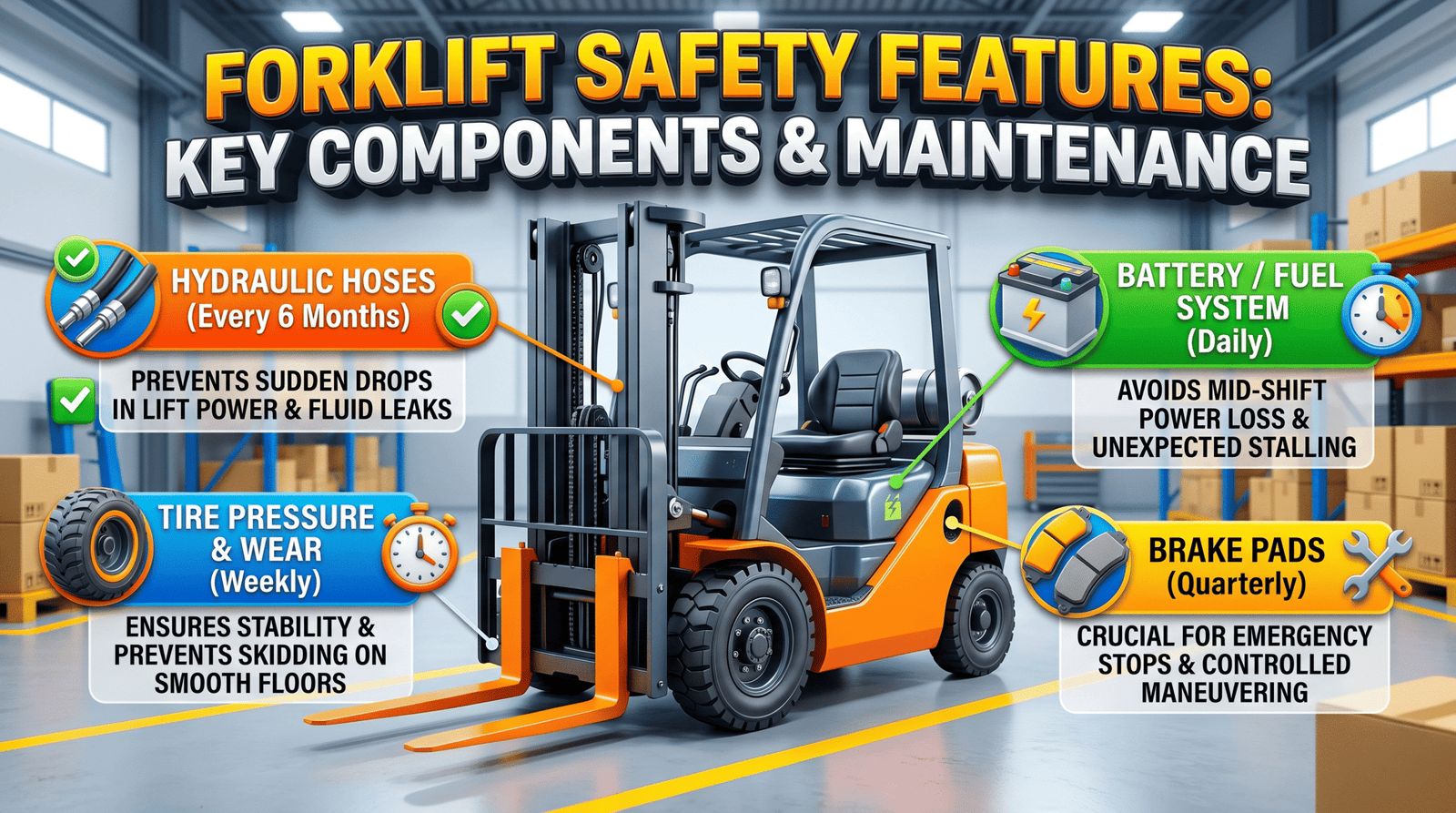
The maintenance schedule should have the following assigned grouping. Forklift safety and impact of downtimes have a direct relation.
Table: Forklift safety Features
| Component Type | Maintenance Frequency | Impact on Safety & Downtime |
| Hydraulic Hoses | Every 6 Months | Prevents sudden drops in lift power and fluid leaks. |
| Tire Pressure/Wear | Weekly | Ensures stability and prevents skidding on smooth floors. |
| Battery/Fuel System | Daily | Avoids mid-shift power loss and unexpected stalling. |
| Brake Pads | Quarterly | Crucial for emergency stops and controlled maneuvering. |
8. Prioritize Ergonomics and Operator Comfort
Worker fatigue leads to workplace accidents. Forklifts that lack operational or ergonomic features can lead to strain and reduce an operator’s attention. When selecting machinery, ensure adjustable seating, easy-to-reach controls, and good visibility. An alert, comfortable workforce is directly correlated to operational uptime and safety.
- For operator size flexibility, provide adjustable seating and armrests.
- To achieve 360-degrees of operator visibility, provide clean mirrors and windshields.
- At best, an operator’s mental focus is aided by working conditions like heat and noise.
9. Use Modern Forklift Technology
Advanced telemetric provide real-time operator behavior and health data concerning the forklift. Impact aware telemetric report unsafe driver behavior like speeding and hard impacts.
Predictive telemetric report on the health of the forklift’s operational components. Modern technology adds value to telemetrics and appeals to forward-thinking large manufacturers.
- Impact sensors can be used to log and report collisions automatically for frontline safety assessment.
- Identify workflow optimization opportunities by monitoring idle time and fuel efficiency.
- Identify driving behavior patterns to single out operators that may require retraining on safety protocols.
10. Forklift Safety Signage and Communication
The foundation for safety in the highly dynamic industrial workplace is effective signage and communication. This could mean visual instructions, inline pathways, or verbal cues between mobile workers and pedestrians.
Safety vests, tape, and signs on the ceiling serve to remind everyone of safety protocols, and reduce complacency, a significant contributor to accidents. Sites with effective signage protect people and equipment, and impress visitors with a testimony of safety consciousness.
- Highly visible, reflective tape in a contrasting color should be used to demarcate permanent pedestrian and forklift “no-go” zones.
- Hand signals or two-way radios should be used to coordinate communication among operators and ground staff in high noise environments.
- At all intersections and blind turns, affix mirrors so that traffic can be monitored.
Frequently Asked Questions: Top 10 Forklift Safety Tips
What are the common causes of Forklift accidents in the warehouse?
Falls, tip-overs and collisions are the common types of accidents that occur in the warehouse. There are various causes of these accidents which include poor training of operators, poor signage, poorly maintained floors, and excessive speed. With adequate training and improved floor management, the incidence of these types of accidents can be reduced by more than 70%.
How often should a forklift be professionally inspected?
Professional inspectors are needed after a certain amount of time; however, operators are required to do their own inspections every day before starting the shift. Forklifts should be inspected every 250 to 500 hours of operation. OSHA regulations state that any forklift that is considered to be defective or unsafe can not be operated and must be repaired by a qualified technician before it can be put back into service.
Can Servicing Forklifts be a lead generator?
Absolutely! Failing to have a well-serviced fleet of vehicles is going to have a negative impact on your business. A fleet that is well serviced and maintained experiences less downtime which means that jobs are completed on time and within budget. This type of environment creates a reliable and business operation which draws a large number of referrals and high-end contracts.
What is the Stability Triangle?
The triangle is comprised of the points of support for a Forklift, in this case the two front wheels and the center of the steer axle. If the center of gravity of a load is within the triangle, the load should not be able to tip. If the center of gravity is outside of the triangle, the forklift will tip. A good understanding of the stability triangle is vital to any operator.
What effect does forklift downtime have on supply chain efficiency?
Without moving inventory, the production line is brought to a standstill. Repair waiting time for employees increase labor cost. This coupled with potential late shipment penalties, stifles company growth and eats into profit.
What safety features are a must have when choosing to buy a forklift?
Look for Operator Presence Systems i.e. the forklift will stop if the driver leaves his seat, automatic slow down when turning, the mast will have a good sight line, and there will be integrated telematics for onboard diagnostics.
How do I identify the correct spare parts for a forklift?
Make sure you identify the parts by consulting the manufacturers guide/manual. Always buy from reputable aftermarket heavy equipment companies like TYPHON Machinery to improve the chances of the spare parts being original, strong, and with good compatibility with the forklift’s hydraulic or electric circuitry.