
How Mini Excavators Improve ROI on Small Job Sites
Nowadays, spatial constraints very often limit the speed and profitability of construction projects in urban areas. Builders who are working in small residential areas, downtown streets, or tight commercial places are on a constant lookout to meet their deadlines while keeping their expenses in control. Let’s understand how a mini excavators improve ROI on job sites and brings tons of profits to small businesses.
The main disadvantages of using heavy earthmoving equipment like mini excavators in these confined areas are their excessive fuel consumption, limited mobility, and high logistical costs. Such a mismatch can harm your project margins resulting in increased timelines and labor costs.
In order to solve these issues, some modern fleet managers and independent contractors have decided to reorder their operations and rely on compact, high-performance machines. This article explores the financial and physical changes resulting in increased ROI through the use of mini excavators at small job sites.
Top 5 Ways in which Mini Excavators Improve ROI on Small Job Sites
1. Large Cuts in Logistical and Transportation Costs
One of the greatest financial wastes that come with buying large equipment is simply the changing of their spots at work. Large excavators often need the use of heavy-haul permits, multi-axle trailers, and commercial-grade transport vehicles. Such logistical costs result in the erosion of your project budget before your buckets have even reached the ground. Small machines skip these obstacles altogether and reorganize your initial mobilization expenses by calculating how can a mini excavators improve ROI.
- Typical Transport Capability: Most compact machines weigh from 1 to 4 tons and can very easily be put on ordinary utility trailers and pulled by pickup trucks without the need for a special permit.
- Lower Transportation Footprint: Due to their compact design, you don’t have to buy or rent heavy-duty low-loaders or pay third-party transport fees, keeping your money within your primary business operations.
- Speedy Site Deployment: The simple loading and unloading process means practically no waiting time between small projects, enabling one machine to perform tasks on separate sites in one working day.
2. Superior Fuel Economy and Lower Daily Running Costs
The operating profits on tight job sites depend very much on repeated fluid consumption and the day-to-day wear of the equipment. A 20-ton excavator, for example, is already expected to consume a big amount of diesel even during idle time used for complex, slow, and precise digging. On the other hand, small units feature highly efficient engines with low displacement which bring down to a large extent the hourly cost of operation.
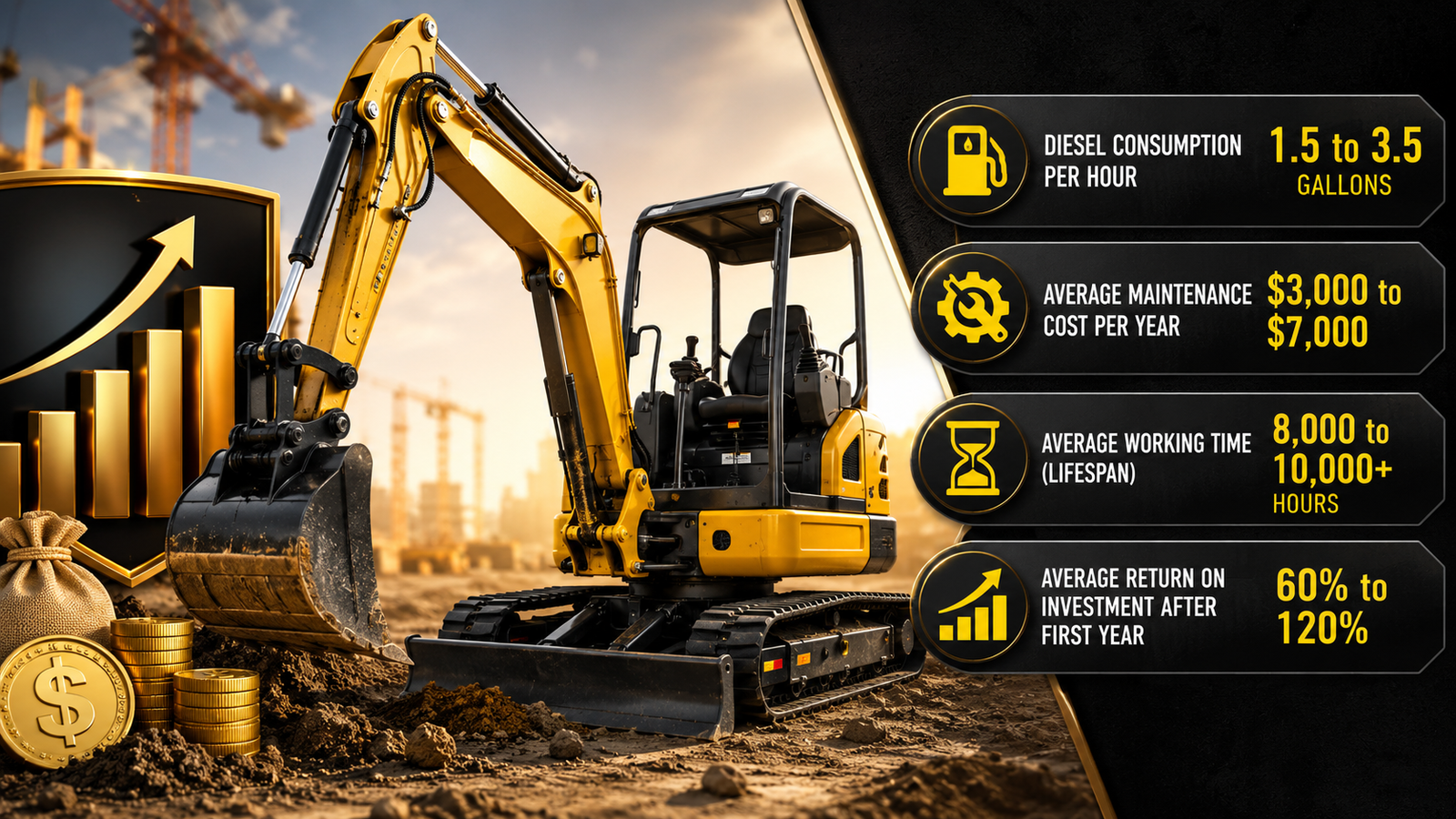
| Parameter | Typical Mini Excavator |
| Diesel Consumption per Hour | 1.5 to 3.5 gallons |
| Average Maintenance Cost per Year | $3,000 to $7,000 |
| Average Working Time (Lifespan) | 8,000 to 10,000+ hours |
| Average Return on Investment after First Year | 60% to 120% |
- Significantly Less Fuel Consumption per Hour: Besides being equipped with extremely efficient engines, compact units are normally powered by well-known and reliable Kubota or similar powertrains that basically use a very small percentage of fuel while still being able to provide an excellent hydraulic force.
- Reduced Replacement and Fluid Expenses: The preventive maintenance rounds require the use of quite a few liters of hydraulic fluid in addition to engine oil and smaller filters replacement, so the budget for maintenance remains quite reliable and lean.
- Lower Costs of Restoring the Ground: Miniature machines with lightweight rubber tracks have very low ground pressure so they will not create deep furrows and damage the existing turf or sidewalks, thus saving thousands of dollars for extra site-repairs after the project.
3. Exceptional Spatial Flexibility and Maneuverability Thanks to Zero Tail Swing
Things that define small-scale projects are physical blockages or limitations such as walls, overhead powerlines, fences, and mature landscaping. A normal-size machine that is not careful enough can bump into one of these elements causing the operator to slow down and work cautiously. On the other hand, compact machines that are specifically designed with special body configurations allow the operator to work even in highly limited spaces without any problems.
- The counterweight of a genuine zero tail swing equipment never protrudes beyond the width of its tracks during a complete 360-degree rotation, enabling the operator to excavate right up against solid walls or property boundaries.
- Operators can adjust the boom even when the cab is fixed on the track in order to dig a trench parallel to a foundation or a structure. This method of digging can be used when the space is very limited and there is not enough room to turn around.
- Most micro models have the undercarriage that can be retracted so that the machine will be able to fit such as backyard gates or interior building doors, etc. which means that the scope of the work you can get is increased.
4. Increased Utilization of Fleet Thanks to Great Versatility with Different Attachments
In order for any machine to generate the best return on investment, it should run actively and bill hours. If an excavator sits idle because the digging is over, then it becomes a financial liability. The incorporation of advanced auxiliary hydraulic lines brings a radical change to a compact platform. It can no longer be considered just a digging tool but rather more as a multi-tool.
- You can turn from excavation to demolition or landscaping in less than 5 minutes by using the attachments such as a hydraulic thumb, post-hole auger, or a concrete breaker.
- If your main machine can handle several roles through separate attachments, you won’t have to spend money on renting a skid steer, walk-behind trencher, and manual jackhammer separately.
- When your attachment arsenal is expanded, your machine will remain relevant throughout every phase of the project cycle—from initial demolition and utility trenching to final grading and landscaping.
5. Less Manual Labor Expenses and Fewer Workplace Injuries
Using manual labor for trenching, foundation making, and material handling is not only very inefficient but also costly. Manual digging is slow, highly dependent on weather conditions, and your company will be exposed to considerable workers’ compensation liabilities because of overexertion injuries. Mechanical power saves and reallocates labor most properly.
- Major Increase in Productivity: Using a mini compact machine, which is operated by one person, a utility trench can be dug in one hour while four laborers working manually would take a whole day to do the same.
- Safety First: Heavy lifting, deep digging, and handling boulders are mechanized processes that help in keeping your staff safe from hazardous trenches and also in reducing repetitive strain injuries.
- Get More Out of Your Workers: When the digging tasks are handed over to mechanical means, your workforce is free for high-skill installation, finishing, and project management roles leading to faster project completions.
Frequently Asked Questions (FAQs) – Mini Excavators Improve ROI on Small Job Sites
What is the average resale period for a mini excavator on small jobs?
Most active participants in the construction industry using the compact units on at least 150 billable days a year would find that their mini excavator pays for itself even within a duration of 2 to 4 years. The payback period is highly dependent on minimizing maintenance costs, making sure that your fleet is used all the time, and matching the equipment with high-yield attachments like hydraulic thumbs or breakers which are used to secure more diverse contract types.
How much can I save on fuel by using a mini excavator instead of a standard one?
A 20-ton excavator operating under relatively heavy load would be expected to consume approximately 4 to 7 gallons of diesel fuel per hour. On the other hand, a compact excavator properly optimized for fuel efficiency would use about 1.5 to 3.5 gallons per hour. This vast difference, when fuel consumption is converted into dollar amounts, can lead to substantial savings.
Is it better to own or rent a mini excavator for maximizing ROI?
For your business, if the need for the machine comes up more than 80 to 100 days a year, then buying or financing a unit will be the option that will give you a much better return on equity over time as it will be your own asset and you will not have to keep paying rental fees. Otherwise, if your projects are spread out over time and are not frequent, then renting is a way to avoid tying up your money in ownership, as well the rental company will take care of the maintenance and storage of the machine.
What are the main applications of a mini excavator on tight residential sites?
Compact excavators are great for a number of applications like digging shallow trenches for foundations, yard leveling, installation of utilities such as water and electrical lines, clearing heavy brush, material handling, and minor demolition work. Their unique layout enables them to easily work in close proximity to trees, fences, pools, etc., and keep the turf damage to a minimum.
Can a mini excavator handle concrete demolition effectively?
With the right size hydraulic breaker or concrete hammer attachment, these small-sized units can very effectively break up driveways, sidewalks, pool decks, and retaining walls. This function helps in the elimination of the use of pneumatic jackhammers, and it can potentially save a lot of labor besides speeding up the preparation work.
How does zero tail swing impact safety and productivity on urban sites?
Zero tail swing means that as the operator rotates the upper structure, the rear counterweight does not go beyond the width of the tracks. This model design ensures there is no danger of accidentally hitting nearby buildings, passing vehicles, people, utility poles, etc., so the operators can work fast and at a comfortable pace with full confidence in the use of space.
What maintenance steps are critical to preserve the resale value of compact machinery?
One must strictly follow the 250-hour engine oil and filter change service intervals along with regularly checking the undercarriage and daily greasing of all main boom pins and bushings in order to retain excellent resale value. Also, it has been observed that very well-maintained, fully documented service records usually carry a price premium of 10% to 20% as compared to machines with poor or even no service records when the owners are trading or selling.